
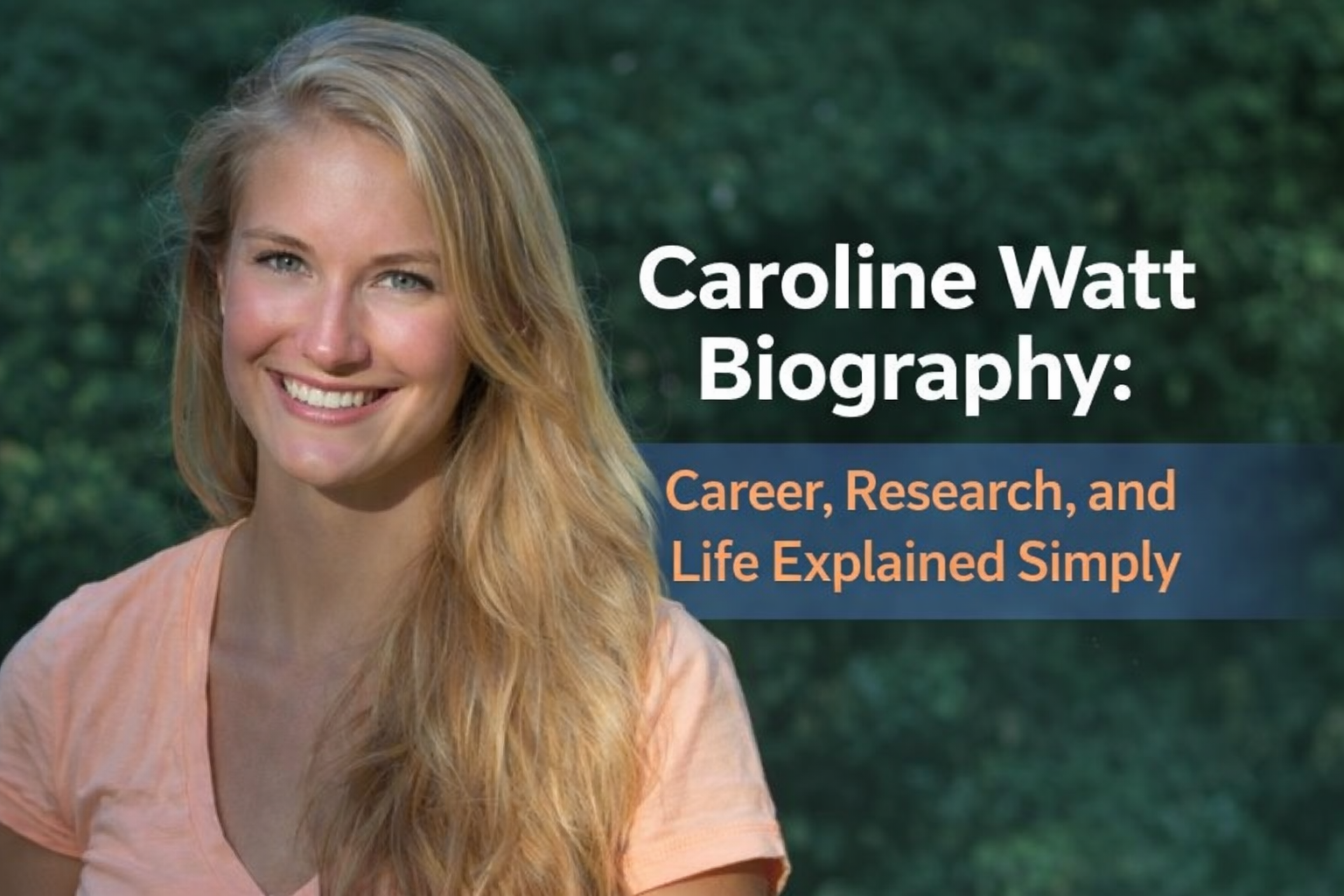
Caroline Watt is best known as a Scottish psychologist and leading expert in parapsychology at the University of Edinburgh, recognized for studying paranormal experiences using scientific methods and critical thinking. She has built a respected academic career by exploring why people believe in supernatural phenomena while promoting evidence-based research and scientific integrity.
Table of Contents
Caroline Watt Quick Bio
| Full Name | Caroline Watt |
|---|---|
| Birth Year | 1962 |
| Birthplace | Perthshire, Scotland |
| Nationality | Scottish |
| Profession | Psychologist, Researcher, Academic |
| Known For | Parapsychology research and scientific study of paranormal experiences |
| Education | University of St Andrews (MA), University of Edinburgh (PhD) |
| Field of Study | Psychology, Parapsychology |
| Famous Role | Koestler Chair of Parapsychology |
| Workplace | University of Edinburgh |
| Major Interests | Human belief, paranormal experiences, cognitive psychology |
| Notable Work | Research on near-death experiences, lie detection myths |
| Books | Parapsychology: A Beginner’s Guide, An Introduction to Parapsychology |
| Collaborators | Richard Wiseman, Dean Mobbs |
| Current Status | Emeritus Professor |
| Known For Approach | Scientific, skeptical, evidence-based |
Introduction
When you hear the word paranormal, you might think of ghosts, psychic powers, or strange unexplained events. Most people either believe in it completely or reject it entirely.
But Caroline Watt chose a different path.
Instead of picking sides, she asked a simple but powerful question:
“What if we study these experiences properly?”
That question turned into a lifelong journey—and made her one of the most respected voices in parapsychology today.
Early Life: Where Curiosity Began
Caroline Watt was born in 1962 in Perthshire, Scotland. She grew up in a calm and thoughtful environment, where curiosity was encouraged rather than shut down.
As a young student, she showed interest in how people think and behave. But what made her stand out was this:
She was not afraid to explore unusual ideas.
While others might laugh at ghost stories or psychic claims, she wondered:
“Why do people experience these things so strongly?”
That mindset—curious, open, but careful—became the foundation of her future work.
Education: Turning Curiosity Into Science
Watt studied psychology at the University of St Andrews, where she earned her MA degree.
During her studies, she faced a challenge that would shape her career.
In an exam, she was asked how she would scientifically study paranormal claims. Instead of giving a simple answer, she carefully explained how experiments could test such ideas.
That answer impressed her professors—and opened a door.
She later joined the University of Edinburgh, where she completed her PhD in psychology under Robert L. Morris, a pioneer in parapsychology.
This mentorship helped her move from curiosity to serious scientific research.
Career Journey: From Student to Leading Scientist
Starting at the Koestler Parapsychology Unit
Caroline Watt began her career at the Koestler Parapsychology Unit (KPU) in Edinburgh.
At that time, the field was often misunderstood. Many people thought it lacked scientific value.
But Watt did not walk away.
Instead, she worked to bring structure, discipline, and evidence into the field.
She started as a research assistant and gradually built her expertise step by step.
Climbing the Academic Ladder
Her career grew steadily through dedication and careful work:
- Research assistant
- Research fellow
- Senior lecturer
- Professor of Parapsychology
In 2016, she achieved a major milestone when she became the Koestler Chair of Parapsychology.
This role is rare and prestigious. It shows that her work earned respect in a challenging field.
Later, she became an Emeritus Professor, which means she retired from full-time teaching but continues to contribute to research and discussions.
What Does Caroline Watt Study?
Let’s make this simple.
Caroline Watt studies unusual human experiences that people often call paranormal.
These include:
- Telepathy (mind reading)
- Precognition (knowing future events)
- Near-death experiences
- Ghost sightings
But here is the key difference:
She does not try to prove these are real.
She tries to understand why people believe they are real.
That small shift changes everything.
Major Research and Scientific Contributions
1. Testing the “Eye Movement Lie Detector” Myth
One of her most well-known studies looked at a popular idea:
Can you tell if someone is lying by watching their eyes?
This belief came from neuro-linguistic programming (NLP) and was widely taught.
Watt, along with psychologist Richard Wiseman, tested it scientifically.
The result was clear:
“There is no evidence that eye movements reveal lying.”
This finding challenged a widely accepted myth and showed the importance of testing ideas instead of trusting them blindly.
2. Understanding Near-Death Experiences
Many people who have near-death experiences report:
- Seeing a bright light
- Feeling peaceful
- Leaving their body
Watt worked with neuroscientist Dean Mobbs to explore this.
Their research suggested these experiences can be explained by:
- Brain activity
- Chemical changes
- Lack of oxygen
In simple words, what feels supernatural may actually be a natural brain response.
3. Improving Research Standards
Parapsychology has often been criticized for weak research methods.
Watt noticed a serious problem:
Studies with positive results were more likely to be published than negative ones.
This creates bias.
To fix this, she helped introduce study registries, where researchers must register their studies before starting them.
This improved transparency and made the field more trustworthy.
4. Exploring Why People Believe
One of her most fascinating areas of work focuses on belief itself.
She studies questions like:
- Why do people believe in ghosts?
- Why do memories feel so real, even when they are not?
- How do emotions shape belief?
Her findings show that belief is not just about facts.
It is also about experience, memory, and psychology.
Books and Academic Work
Caroline Watt has written and contributed to several important books, including:
- Parapsychology: A Beginner’s Guide
- An Introduction to Parapsychology
These books are known for explaining complex ideas in simple language.
She has also published many research papers and contributed to academic journals, helping students and researchers worldwide.
Leadership and Recognition
Watt’s influence goes beyond research.
She has held important leadership roles, such as:
- President of the Parapsychological Association
- President of the Society for Psychical Research
These roles show that she is trusted not only as a researcher but also as a leader.
Her work helped shape how modern parapsychology is studied today.
Personality and Approach: Curious but Careful
Caroline Watt’s personality is one of her greatest strengths.
She is:
- Curious but not naive
- Skeptical but not dismissive
- Open-minded but evidence-focused
She once shared that she started her career without strong beliefs about the paranormal.
Instead, she focused on questions, not conclusions.
That approach helped her stay balanced in a field filled with strong opinions.
Challenges in Her Career
Let’s be honest—her career path was not easy.
Parapsychology is often criticized by mainstream science.
She faced:
- Skepticism from other researchers
- Limited funding opportunities
- Public misunderstanding
But instead of giving up, she worked harder to improve standards.
Her goal was simple:
Make the field more scientific and credible.
Interesting Facts About Caroline Watt
- She helped bring scientific discipline to a controversial field
- She worked at one of the world’s leading research units for parapsychology
- She collaborates with experts from psychology, neuroscience, and cognitive science
- She focuses more on understanding belief than proving paranormal claims
Here’s a fun way to think about her work:
She studies not ghosts—but why people think they see ghosts.
Why Her Work Matters Today
In today’s world, misinformation spreads quickly.
People still believe in:
- Psychic predictions
- Energy healing
- Supernatural encounters
Watt’s work helps people think more clearly.
Instead of mocking beliefs, she explains them.
That approach builds understanding rather than conflict.
Her research helps bridge the gap between:
- Science and belief
- Experience and evidence
Conclusion
Caroline Watt’s story is not about chasing ghosts.
It is about understanding the human mind.
From a curious student in Scotland to a leading professor, her journey shows the power of asking the right questions.
She reminds us that:
You do not need to believe everything you hear.
You just need to understand why it feels real.
And sometimes, that is even more interesting.
FAQs About Caroline Watt
1. Who is Caroline Watt?
Caroline Watt is a Scottish psychologist known for her work in parapsychology and the scientific study of paranormal experiences.
2. What is Caroline Watt famous for?
She is famous for studying paranormal beliefs using scientific methods and for debunking myths like detecting lies through eye movements.
3. Where did Caroline Watt work?
She worked at the University of Edinburgh and was the Koestler Chair of Parapsychology.
4. Does Caroline Watt believe in the paranormal?
She takes a balanced view. She studies paranormal claims scientifically but focuses on evidence rather than belief.