
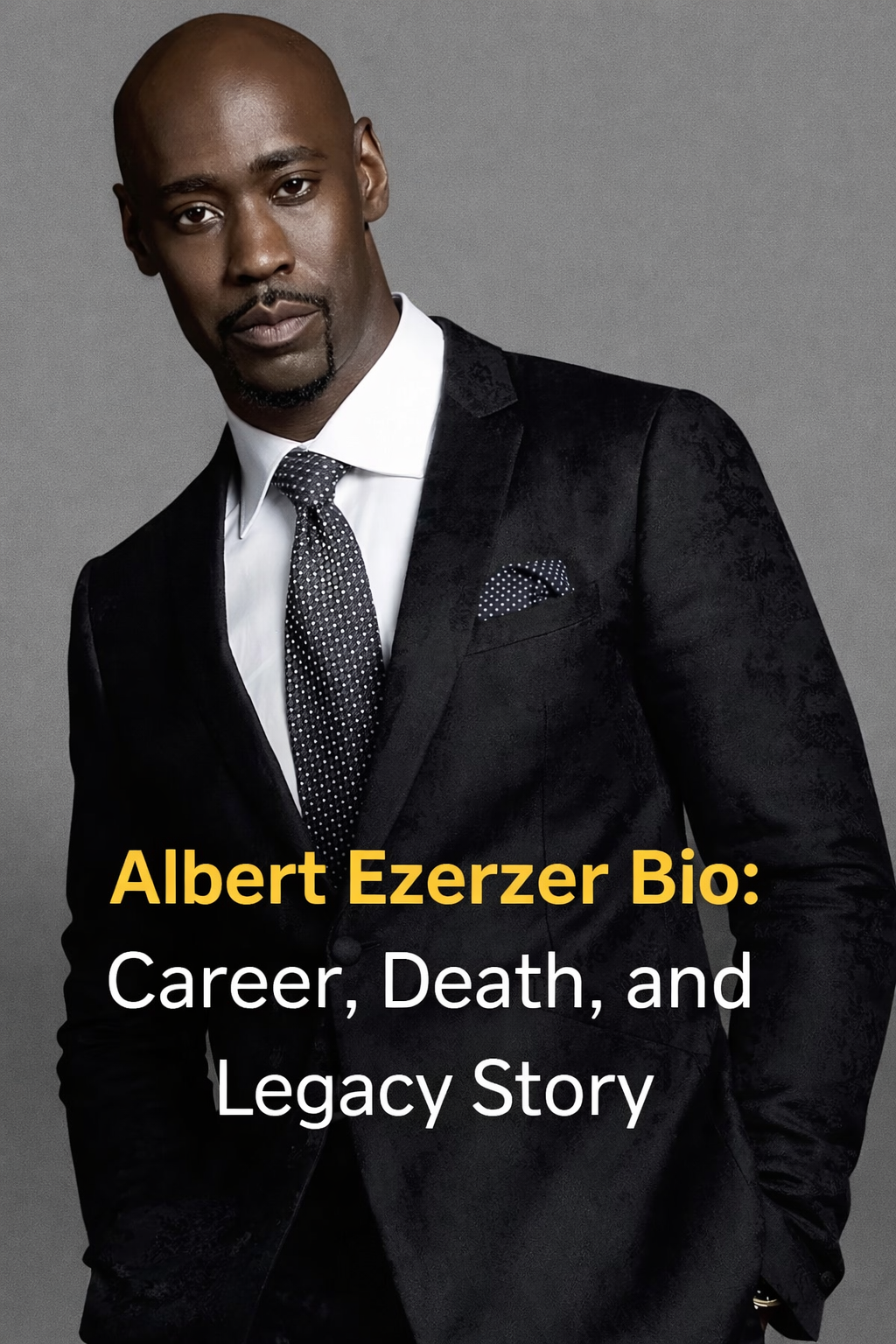
Albert Ezerzer was a film and television crew member who worked in the transportation department behind the scenes. He was not an actor, but he played an important role in helping productions run on time by moving cast, crew, and equipment where they needed to go. Many people learned his name after the TV series Suits honored him with the message, “In memory of Albert Ezerzer.” He passed away in 2014, and his tribute reminded viewers that the entertainment world depends not only on stars on screen, but also on the hardworking people behind the camera.
Table of Contents
Albert Ezerzer Quick Facts
| Category | Details |
|---|---|
| Full Name | Albert Ezerzer |
| Date of Birth | January 31, 1959 |
| Date of Death | May 9, 2014 |
| Age at Death | 55 years |
| Profession | Film and TV crew member |
| Department | Transportation (behind the scenes) |
| Known For | Work on Suits and other productions |
| Famous Tribute | “In memory of Albert Ezerzer” in Suits |
| Career Role | Transporting cast, crew, and equipment |
| Notable Works | Interstate 60, Tart, Covert One: The Hades Factor |
| Public Presence | Private individual, no major public interviews |
| Cause of Death | Reported as ruptured aortic aneurysm |
| Common Confusion | Mistaken for D. B. Woodside |
| Legacy | Respected behind-the-scenes professional in film industry |
Introduction
Most people meet Albert Ezerzer’s name in a quiet and emotional way. They are watching Suits, the episode ends, and a tribute appears on screen. It says, “In memory of Albert Ezerzer.” That short line sparks a very human question. Who was he?
It is a powerful question because Albert Ezerzer was not a celebrity in the usual sense. He did not walk red carpets. He did not give interviews. He did not build fame from public attention. He built his reputation through work, reliability, and trust. That makes his story different from the usual Hollywood biography. It also makes it more meaningful.
Albert Ezerzer’s life shows how the film and television industry really works. A successful production does not happen because of actors alone. It also depends on drivers, assistant directors, camera crews, costume workers, editors, lighting teams, and transportation staff. When one of those people is excellent at the job, everyone around them feels it. When one of them is gone, the loss feels real.
This article gives a full and careful look at Albert Ezerzer’s life, career, legacy, and the confusion that still surrounds his name online. It also explains what is known, what is not publicly confirmed, and why his story still matters years after his passing.
Why People Still Search for Albert Ezerzer
Albert Ezerzer became widely known to the public because of the tribute in Suits. Before that, he was known mostly inside the working world of film and television. That is common for crew members. Their names matter deeply on set, but viewers at home may never hear them unless something special happens.
In Albert’s case, the tribute made thousands of viewers curious at once. Some thought he might have been an actor. Others thought he may have played a character in the show. Some even confused him with actor D. B. Woodside. That mix of curiosity and confusion turned Albert Ezerzer into a much-searched name online.
What keeps that interest alive is not only the tribute itself. It is also the feeling behind it. People can sense that the message was personal. It was not a random note. It was a sign that someone important to the production had passed away. That emotional weight pushed viewers to learn more.
There is also another reason. Albert’s story feels real in a way that many celebrity stories do not. It reminds people of the hardworking men and women who keep things moving without asking for attention. That kind of life earns respect.
Albert Ezerzer’s Early Life
Albert Ezerzer was born on January 31, 1959. Public information about his early life is limited. That means there is no widely confirmed record of his hometown, his parents, his schooling, or the details of his childhood in the public domain.
Some readers may find that surprising, but it actually fits the kind of life he lived. Albert was a private working professional, not a public figure who built a career from media exposure. Because of that, many details that people often expect in a biography simply were never placed into the public record.
That absence matters. It tells us something about the boundary between public curiosity and private life. In Albert’s case, the most honest way to write about him is to say clearly that some parts of his personal background remain private or unknown. A trustworthy biography should never fill gaps with invented details.
Even with limited public information, one thing seems clear. Albert belonged to the class of film workers whose lives revolve around practical skill, discipline, and consistency. These are people who earn trust over time. They do not become respected because of headlines. They become respected because they show up, solve problems, and keep things moving.
A Quiet Career in a Loud Industry
Hollywood is a loud business. It loves faces, names, fashion, and headlines. But behind that noise sits a massive system of workers whose names most viewers never learn. Albert Ezerzer worked in that hidden system.
He built his career in the transportation department. On paper, that may sound simple. In real life, it is one of the key pieces of any production. Transportation teams handle movement, timing, access, and logistics. They make sure actors get to set, crew members reach the right place, and production schedules stay on track. They also help move equipment and support the daily rhythm of filming.
Think about a large TV set like a moving machine. Every person must be in the right place at the right time. If one piece slips, the whole day can change. Transportation workers reduce that risk. They help protect the schedule, and in production, the schedule is everything.
That is why people in these jobs matter so much. They work long hours. They deal with stress, weather, traffic, changing call times, and last-minute shifts. They need patience and calm judgment. They also need discretion, especially when working around high-profile actors or expensive equipment. A good transportation worker becomes someone others depend on without always saying so out loud.
Albert Ezerzer appears to have been exactly that kind of person.
What Albert Ezerzer Actually Did on Set
Many articles mention that Albert worked in transportation, but it helps to explain what that really means. A transportation crew member may drive cast members, deliver crew to shooting locations, coordinate vehicle timing, and help solve location-to-location movement problems. On some productions, these jobs can begin before sunrise and continue late into the night.
This is not just driving from one place to another. It is operational work. It involves planning, punctuality, safety, and communication. If a production shoots in multiple locations, transportation becomes even more important. The team has to keep the day from falling apart.
A person in Albert’s role needed to be dependable. Directors and producers may not talk about transportation in interviews, but they feel its value every single day. So do actors. When a production runs smoothly, the people who support that smooth movement deserve part of the credit.
That is one reason Albert’s name meant something to the people who knew him. He was part of the machinery that allowed everyone else to do their jobs.
Career Credits and Professional Work
Albert Ezerzer worked on several productions during his career. He has been linked with titles such as Interstate 60, Tart, and Covert One: The Hades Factor. These credits place him in the practical, working side of the entertainment industry rather than its public spotlight.
What stands out here is not just the titles themselves, but the pattern they suggest. Albert appears to have built a steady career over time. That kind of career does not happen by accident. In the screen industry, people hire crew members again when they trust them. Reliability leads to more work. Good word of mouth matters. Professional behavior matters.
This is one of the strongest quiet signs of Albert’s value. He was part of a world where reputation travels quickly. People remember who can handle pressure. They also remember who treats others well. A person does not last in this field unless others feel confident working with them.
When I look at Albert Ezerzer’s story, that is one of the most striking things. He may not have left behind long interviews or public speeches, but the fact that he was remembered at all by a major television production says a lot. It suggests he left a strong impression where it mattered most, among colleagues.
Albert Ezerzer and Suits
For most modern readers, Suits is the reason Albert Ezerzer’s name lives on. The legal drama developed a large audience, and its fans tend to pay close attention to character arcs, cast members, and episode details. So when the show included a memorial tribute to Albert, fans noticed immediately.
The tribute appeared in connection with the show after Albert’s death in 2014. For many viewers, it was a small but moving moment. The memorial told them that someone tied to the show had passed away. It did not explain more. That silence made people search.
The message itself became the most widely repeated line associated with Albert Ezerzer:
“In memory of Albert Ezerzer.”
That sentence is simple, but it carries a lot of feeling. It tells viewers that Albert was valued enough to be honored publicly by the production team. In television, that kind of tribute is meaningful. Shows do not make space for such messages lightly. When they do, it usually means the person mattered deeply to the cast and crew.
Albert was not part of the on-screen cast of Suits. He worked behind the scenes. That point matters because many readers still arrive with the wrong impression. The tribute was not for a guest actor or fictional character. It was for a real crew member whose labor supported the making of the show.
The Aaron Korsh Quote and What It Means
One of the most important public comments tied to Albert Ezerzer came from Suits creator Aaron Korsh. In a brief but clear statement, he explained:
“Albert worked in our transpo department & passed away recently.”
This quote matters for two reasons. First, it settles the question of who Albert was. He worked in transportation. Second, it shows the direct link between Albert and the Suits team.
The wording also feels human and immediate. It does not sound polished for publicity. It sounds like a colleague explaining a loss. That gives it emotional weight. It also supports the larger truth about Albert’s place in the production. He was not visible to the audience, but he was visible to the people who made the show.
In my view, this short statement says more than a long tribute might have. It points to the respect Albert earned through work. It reminds us that in a professional setting, people become memorable not only for talent, but also for character and consistency.
The Confusion With D. B. Woodside
One of the strangest parts of Albert Ezerzer’s online story is the repeated confusion between him and actor D. B. Woodside. This mix-up became widespread after viewers searched for Albert’s name and found incorrect images and posts.
The confusion likely happened because public photos of Albert were very limited, while D. B. Woodside was a visible actor with a connection to Suits. Once a few mistaken posts appeared, the error spread quickly. That is a common internet problem. A wrong idea gets repeated so many times that it starts to look true.
But Albert Ezerzer and D. B. Woodside were not the same person. Woodside is an actor known for roles in shows such as Buffy the Vampire Slayer, 24, Lucifer, and Suits. Albert was a crew member in transportation. Their careers, roles, and public identities were completely different.
A quote often tied to Woodside’s response to the confusion is this:
“This is me. Both pictures.”
That line helped push back against the false identification. It was short, direct, and needed. The confusion says less about either man and more about how easily online misinformation spreads when reliable details are scarce.
This part of Albert’s story is important because it teaches a bigger lesson. When someone lives privately, the internet often tries to fill the empty space with guesses. A careful biography should resist that urge and stick to what can be said honestly.
Personal Life and Family History
People often want to know about a subject’s family, marriage, children, and close relationships. In Albert Ezerzer’s case, the public record is limited. There is no widely confirmed and detailed account of his parents, siblings, spouse, or children available in mainstream public sources.
That does not mean those relationships did not exist. It simply means they were not made public in a reliable way. A responsible article has to respect that line.
What we can say is that Albert’s life seems to have stayed grounded in work rather than publicity. He appears to have kept his personal circle private. In many ways, that choice fits the rhythm of crew life. People in this part of the industry often work long hours, build strong professional friendships, and keep their family lives away from public attention.
It is also likely that his closest collaborators were not celebrities, but coworkers. On a film or television set, crew bonds can become very strong. Long days, tight deadlines, and shared pressure create a real sense of team. For someone like Albert, those working relationships may have shaped a large part of daily life.
That is worth remembering when people ask about “key collaborators.” In Albert’s world, collaboration did not always mean famous names. It meant the assistant who coordinated timing, the driver who covered another shift, the location team that needed support, and the production staff who trusted him to deliver. Those are real collaborations too.
Was Albert Ezerzer Famous?
Not in the usual way. Albert Ezerzer was not a public celebrity. But fame is not the only measure of importance. In fact, his story works best when we stop forcing celebrity rules onto it.
Albert mattered because he was useful, dependable, and respected. That kind of importance rarely trends, but it lasts. You can see it in the way people still ask about him. They do not ask because he gave sensational interviews or lived a dramatic public life. They ask because a production stopped to honor him.
That is one of the quiet truths of the entertainment business. Some of the most valued people are not famous at all. They are the ones who make difficult work possible. They keep others calm. They protect the flow of the day. They become essential.
Albert’s story reminds us to widen our idea of success. Public recognition is one form of success. Being deeply trusted by coworkers is another.
Albert Ezerzer’s Death
Albert Ezerzer passed away on May 9, 2014, at the age of 55. That fact appears consistently in public references to him. His death is what led to the memorial tribute in Suits and to the wave of public interest that followed.
Many online sources say he died from a ruptured aortic aneurysm. That cause has been widely repeated, though some public write-ups present it more as a reported cause than as a formally detailed public medical statement. The careful thing to say is that this is the cause most often associated with his passing in public discussions.
Whatever the exact medical reporting, the larger truth is clear. His death appears to have been sudden and painful for the people around him. The way Suits honored him suggests that his passing was felt personally on the production.
Loss can reveal value. Sometimes people outside a workplace do not fully understand what someone meant until colleagues publicly grieve them. That seems true here. Albert’s death brought attention to a life that had mostly unfolded outside public view.
The Meaning of His Legacy
Albert Ezerzer’s legacy is not built on awards, interviews, or public speeches. It is built on memory, gratitude, and the kind of respect that coworkers do not give unless it is earned.
His story matters because it shines light on the invisible labor behind film and television. Every set depends on people who solve practical problems all day long. Most viewers never know their names. Albert became one of the rare few whose name reached the audience. Once it did, it stood for something larger than one man alone. It stood for the thousands of behind-the-scenes workers who keep the industry alive.
I think that is why the story stays with people. Albert’s life feels both specific and universal. It is specific because it belongs to one person, one career, and one loss. It is universal because it reflects a truth many people know from ordinary life. The person who keeps things running often gets the least attention.
And yet, when that person is gone, everyone notices.
No Known Public Controversies
A complete biography should address controversy when it exists. In Albert Ezerzer’s case, there are no widely known public controversies connected to his name. The only major public issue around him has been the online confusion about his identity, especially the repeated false connection with D. B. Woodside.
That absence of scandal is not a missing piece. It is part of the truth of his story. Albert seems to have lived and worked without public drama. That fits the broader pattern of a quiet professional life.
Sometimes an honest biography is not dramatic. Sometimes its strength comes from steadiness. Albert’s story appears to be one of those cases.
Why His Story Feels So Human
Some biographies feel large because they are packed with headlines. Others feel large because they touch something simple and true. Albert Ezerzer’s story belongs in the second group.
He was a working man in a demanding industry. He did a job that many people ignore. He earned enough respect that a successful television series publicly honored him after his death. That is not flashy, but it is deeply human.
There is something moving about a person whose name becomes known only because others wanted to remember him. That kind of attention is very different from celebrity. It grows out of affection and respect.
For readers, that makes his story easy to connect with. Almost everyone has known a person like this in some form. The one who always shows up. The one who gets things done. The one who makes everyone else’s day easier. The one people miss the moment they are not there.
Albert Ezerzer seems to have been that kind of person.
What Albert Ezerzer Teaches Us About the Film Industry
If you only watch what appears on screen, you miss most of the work. The film and television world depends on giant teams. Transportation departments, in particular, deal with one of the least glamorous but most essential parts of production: movement.
People have to arrive safely. Equipment has to get where it belongs. Timing has to hold. Production days are expensive, and even small delays can create bigger problems. That makes transportation staff quietly central to the whole operation.
Albert’s life gives readers a chance to appreciate that hidden structure. It also helps explain why a crew member could receive such a sincere tribute. Inside the industry, a dependable transportation worker is not a small figure. That person can make the whole day possible.
When viewers learn this, the memorial to Albert feels even more meaningful. It stops being a mystery and becomes a window into how much productions rely on their crew.
Final Thoughts
Albert Ezerzer was not a star, and that is exactly why his story matters. He represents the people who build the entertainment world from the ground up without asking for applause. He worked behind the scenes, helped productions function, and earned the kind of respect that lasts beyond a person’s lifetime.
The tribute in Suits gave the public a rare glimpse of that respect. It also gave Albert a place in the memory of viewers who never met him but wanted to know his story. What they found was not a famous actor or a tabloid figure. They found a hardworking crew member whose life reminds us that good work, steady character, and quiet dedication still matter.
In a world that often celebrates only the visible, Albert Ezerzer’s story asks us to look again. The people behind the scenes matter too. Sometimes they matter more than we realize until they are gone.
Frequently Asked Questions About Albert Ezerzer
Who was Albert Ezerzer?
Albert Ezerzer was a film and television crew member who worked in the transportation department. He helped move cast, crew, and equipment for productions and became widely known after Suits honored him with a memorial tribute.
Was Albert Ezerzer an actor in Suits?
No. Albert Ezerzer was not an actor in Suits. He worked behind the scenes in transportation and supported the production off camera.
Why did Suits dedicate an episode to Albert Ezerzer?
The show honored Albert because he was a valued crew member who had passed away. The tribute showed that he mattered deeply to the people who worked with him.
Is Albert Ezerzer the same person as D. B. Woodside?
No. They were different people. Albert Ezerzer was a crew member, while D. B. Woodside is an actor. Online confusion happened because incorrect photos and posts spread after the Suits tribute.
What did Albert Ezerzer do for a living?
He worked in film and television transportation. That work likely included moving people and production needs safely and on schedule during shoots.
How did Albert Ezerzer die?
Albert Ezerzer died on May 9, 2014. Many public sources say he died from a ruptured aortic aneurysm, though personal medical details were never broadly discussed in depth in public.
How old was Albert Ezerzer when he died?
He was 55 years old.
Why is Albert Ezerzer still searched online?
People still search for him because of the Suits memorial, the emotional impact of the tribute, and the confusion that spread online about his identity.
What movies or shows did Albert Ezerzer work on?
He has been linked with productions such as Interstate 60, Tart, Covert One: The Hades Factor, and work connected to Suits.
What is Albert Ezerzer’s legacy?
His legacy is the respect he earned as a behind-the-scenes professional. He stands as a reminder that film and television depend on many skilled workers whose names the public may never know, even though their contribution is essential.
Read More Latest Stories: Intelligentmagazine.co.uk